MBB and SMBB solar panels play an important role in modern photovoltaic systems thanks to their busbar technologies, which enable electrical current to be transferred more efficiently across the solar cell. Compared with conventional busbar designs, these technologies use multiple conductive paths to shorten the current flow distance within the cell and help reduce electrical losses. So, which is more efficient: MBB or SMBB? The answer depends on several factors, including the cell technology, operating conditions, project scale, available installation area, and overall investment cost.
What Is an MBB (Multi Busbar) Solar Panel?
MBB, or Multi Busbar, is a solar cell technology that uses multiple busbars to collect and transfer electrical current over shorter distances. Increasing the number of busbars helps distribute current more evenly across the cell while supporting lower resistive losses. This structure can also help maintain electrical connectivity if microcracks occur or develop within the cell.
One of the key advantages of MBB technology is its ability to provide a balanced solution between electrical performance and manufacturing cost. For this reason, MBB panels are widely used across different types and scales of photovoltaic applications. However, panel selection should not be based solely on the number of busbars. Cell technology, panel power output, temperature coefficient, and overall panel design should also be considered, as total system performance depends on how these characteristics work together.

Get a Quote for Your Project
Contact our expert team for solar power plants, solar panels, and industrial energy solutions.
What Is an SMBB (Super Multi Busbar) Solar Panel?
SMBB, or Super Multi Busbar, is an advanced version of Multi Busbar technology that uses a greater number of thinner busbars across the solar cell. With more conductive paths, the distance that electrical current needs to travel within the cell can be reduced. This helps minimize electrical resistance and associated power losses. SMBB technology is particularly important in high-power, next-generation solar panels designed to deliver higher energy output.
Another advantage of SMBB technology is that the thinner conductive lines can reduce the amount of cell surface area blocked by the busbars. This can allow more sunlight to reach the active area of the cell and contribute to higher electricity generation. Daxler Energy's SMBB solar panel solutions are designed to benefit from these next-generation technologies for applications requiring high power output.
MBB vs. SMBB: Which Solar Panel Is More Efficient?
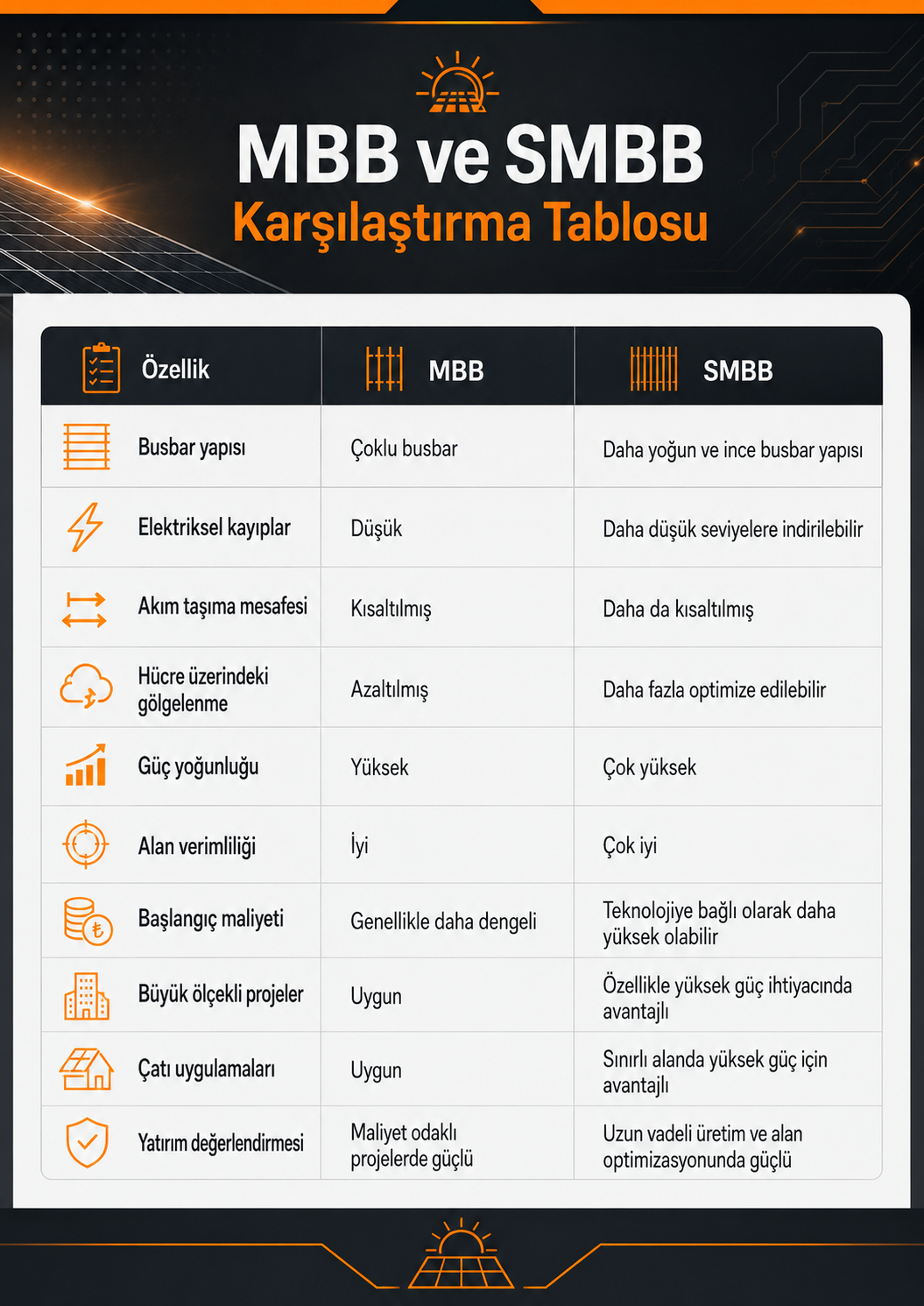
The efficiency difference between MBB and SMBB cannot be determined by busbar count alone. However, because SMBB uses a greater number of thinner busbars, it can shorten current paths and help reduce resistive losses. Therefore, when comparing panels with the same cell technology and similar overall design characteristics, SMBB can provide an advantage.
Difference in Internal Resistance and Energy Loss
When electricity generated by a solar cell travels through its conductive pathways, it encounters a certain level of electrical resistance. As the conductive path becomes longer, resistive losses can increase. The greater number of busbars used in SMBB designs can shorten the distance current travels across the cell and help reduce these losses.
MBB technology already represents a significant improvement over conventional busbar designs. However, the denser conductive structure of SMBB can further support electrical performance optimization, particularly in high-power solar panels. For projects focused on long-term energy production, SMBB can therefore be an attractive technology option.
Performance Under Low-Light and High-Temperature Conditions
Solar panel performance should not be evaluated only under ideal conditions with strong sunlight. Morning and evening hours, cloudy weather, and high temperatures can all affect real-world energy production. A cell and panel design focused on reducing electrical losses can contribute to more consistent energy generation under changing environmental conditions.
Temperature coefficient is also an important parameter because the electrical characteristics of solar cells change as temperatures rise. Therefore, the advantages of SMBB should be assessed together with other panel specifications, including temperature performance. A higher busbar count alone does not guarantee the same level of efficiency improvement under every operating condition.
Cost and Return on Investment
Due to their advanced manufacturing technologies, SMBB panels may have a higher initial cost than MBB panels in some cases. However, higher power output per panel, lower electrical losses, and better use of available installation space can positively affect the overall project economics.
High-power SMBB panels can be particularly advantageous for projects where roof or land availability is limited and maximizing energy production from a specific area is a priority. On the other hand, MBB technology can remain a well-balanced option for projects where lower upfront investment is a key consideration.
MBB vs. SMBB Solar Panel Comparison Table
Which Panel Is Best for Different Applications?
The choice between MBB and SMBB should not be based solely on technical specifications. The available installation area and the project's energy requirements should also be considered. The same panel technology can provide different advantages depending on the application.
Residential and Small Rooftop Applications
For residential installations, the number of panels, available roof space, and total system capacity are important selection criteria. Where roof space is limited, high-power SMBB panels can help achieve the desired system capacity with fewer panels. This can improve the use of available installation space.
For larger rooftops where installation space is less restrictive and minimizing the initial investment is a priority, MBB panels can also be a suitable option. The right choice should be based on a combined assessment of expected annual energy production and total system cost rather than panel technology alone.
Industrial and Large-Scale Solar Projects
For industrial facilities and large-scale solar projects, reducing the number of panels, optimizing land or rooftop usage, and maximizing energy production can provide significant advantages. Thanks to their high-power panel options, SMBB technology can be particularly attractive for these types of projects.
However, large-scale projects require more than panel efficiency to be considered. Inverter compatibility, site conditions, cabling, operating temperatures, maintenance requirements, and installation design can all affect overall system performance. For this reason, a project-specific technical assessment is essential when selecting the most suitable panel technology.
SMBB and TOPCon: The Next Step in Solar Panel Efficiency
Combining SMBB busbar technology with high-efficiency solar cell technologies is an important approach for improving the performance of next-generation solar panels. In particular, TOPCon cell technology can be combined with SMBB designs to support higher cell efficiency and improved overall panel performance.
The combination of these technologies can offer advantages for projects targeting high power output, lower electrical losses, and increased energy generation where installation space is limited. However, actual field performance should always be evaluated by considering the panel's complete technical specifications, installation conditions, and local climate data. Looking only at the nominal power rating is therefore not enough; a comprehensive system analysis is essential.
Daxler Energy MBB and SMBB Solar Panels
Daxler Energy develops high-performance photovoltaic panel solutions for residential, commercial, and industrial applications, offering technologies designed to meet different energy requirements. When selecting a solar panel, factors such as power output, cell technology, and long-term energy performance should be evaluated together. For more detailed product information and available solutions, explore Daxler Energy's solar panel solutions.
The real value of a solar panel is determined by more than its nominal power rating or busbar count. Temperature coefficient, cell technology, mechanical durability, warranty conditions, and expected annual energy production should also be considered when making an investment decision. This approach allows project owners to evaluate long-term energy generation and return on investment rather than focusing solely on the initial purchase cost.
Daxler Energy's SMBB and TOPCon Manufacturing Standards and Quality Assurance
Daxler Energy's next-generation panel solutions combine technologies such as SMBB and TOPCon to support high-power and high-efficiency solar applications. When evaluating a solar panel, quality control processes, cell performance, panel design, and manufacturing standards should be considered as part of a complete quality approach.
For a long-term photovoltaic investment, maintaining performance over the years is just as important as the panel's initial power output. Project owners should therefore review product datasheets, warranty terms, performance guarantees, and the environmental conditions of the installation site before making a final decision.
Frequently Asked Questions About MBB and SMBB Solar Panels
Is it worth upgrading from MBB panels to SMBB panels?
Upgrading from MBB to SMBB depends on factors such as the age of the existing system, inverter configuration, panel power ratings, and available roof or land area. For a new investment, SMBB technology can be advantageous when higher power output and better space utilization are priorities. For existing systems, however, the electrical compatibility of the entire system should be assessed rather than replacing panels based on technology alone.
Do SMBB panels last longer than MBB panels?
The higher number of busbars used in SMBB technology can contribute to electrical connectivity and reliability. However, panel lifespan is not determined by busbar technology alone. Cell structure, encapsulant quality, glass and frame design, manufacturing quality, and environmental conditions also have a significant impact on long-term durability.
Are SMBB panels the same as half-cut solar panels?
No. SMBB and half-cut refer to different solar panel technologies. SMBB relates to the busbar structure used on the solar cell, while half-cut technology involves dividing solar cells into two sections and using them in different electrical configurations within the panel. These technologies can be used together in the same solar panel and are not alternatives to each other.
What is the warranty period for SMBB panels?
The warranty period for SMBB panels varies depending on the manufacturer and product model. Product warranties and performance warranties may also have different terms and conditions. Before purchasing, buyers should review the current warranty terms and performance guarantee provided in the relevant product documentation.
Can SMBB panels be added to an existing MBB system?
Whether SMBB panels can be added to an existing MBB system depends on the electrical design and compatibility of the system. The panel's operating voltage, current, maximum system voltage, inverter specifications, and compatibility with the existing panels should all be checked. Using panels with different power ratings and electrical characteristics within the same string may not always provide optimal performance. A professional technical assessment is therefore recommended before making changes to an existing system.
In conclusion, choosing between MBB and SMBB should involve more than simply comparing the number of busbars. Panel efficiency, power output, temperature performance, cost, installation area, and overall project requirements should all be evaluated together. In general, SMBB technology offers a strong solution for next-generation systems focused on high power output and space efficiency, while MBB technology can remain an attractive option where cost and performance need to be balanced. The right choice ultimately depends on the technical and economic requirements of each project.